

My paternal grandfather was known as a moderate guy. He never leaned too far in one direction. He enjoyed discussing politics but didn’t fit in perfectly with either party. He walked a lot but didn’t specifically exercise. He drank every night but wasn’t a lush.
He also had eight kids (including my dad). So in this one aspect of his life, he took extreme to the extreme.
When asked about having so many kids, he’d always give the same answer: “Well, which one would you give up?”
He makes a good point, but parenting is also really hard and there are only 24 hours in a day. He was an accomplished CPA and executive after being born on a farm in Minnesota with no electricity. He was the first Newcombe to go to college.
But still, eight kids is a lot (the average number of kids in the U.S. is 1.94). Even for someone who overcame Minnesota winters with no heat.
We want people to act the same way all the time and take it as a personal offense when they do not. We watch documentaries hoping the subject does something unexpected. We listen to true crime podcasts secretly rooting for the seemingly “normal” person to snap. We feign shock when a previously squeaky-clean celebrity gets canceled. We seek predictability and character archetypes in real life and we clutch our pearls when life inevitably doesn’t work like that.
Take my relationship to fantasy football. I have mixed emotions about fantasy football.
On the one hand, I love it.
I am in five leagues (four for money and one family league). I spend the majority of August listening to podcasts preparing for my drafts. I develop a real kinship with the players on my fake team. In fact, I become so invested in the prospects of success for certain players that while I should diversify who fills my fake rosters, I do not. If I like a guy, I like a guy and end up drafting him across multiple teams. This works well when my guys go off (score points) but increases the volatility of my collective teams’ scoring (when “my guys” don’t do well, all my teams suffer).
On the other hand, I think fantasy might be ruining the sport for me.
Fantasy is supposedly a game of skill, and it sort of is, but there is a lot of luck involved. You play a head-to-head game against an opponent. There is nothing you can do to impact your opponent’s score, yet their score is one of two factors that decide who wins that week (your score being the other). It’s arbitrary. If the team I cheer for in real life wins, but my fantasy team loses, I get sad. If a player on my favorite real team scores but I’m going against him in fantasy, my feelings are muddled.
I know people who have walked away from fantasy for this reason. They said that it ruined the games for them. I get it. The fantasy seasons usually only lasts until the second-to-last week of the season since some of the real playoff positions might already be set and the best players (real and fantasy) might rest that last week. What’s surprising is that I almost enjoy watching football more during that last week and into the playoffs, when I don’t have specific guys I am rooting for to do one thing. It’s liberating.
This realization actually prodded me to try something different this year. I did almost everything the same—scoured the waiver wire (where you pick up players), evaluated potential trades and set my lineup. But here’s the big difference: Once the games start, I don’t check my scores. Again, there is nothing I can do about it other than stress. I wait until the Monday night game is over, zeros on the clock, and then I check one time to see if I won or lost.
“A coward dies a thousand deaths; a hero dies but once.” – William Shakespeare. Or maybe it was LaDainian Tomlinson.
And you know what? It has helped. I am less emotionally attached to these fake teams.
It’s like deleting Instagram. It sounds crazy until you do it. Only then do you realize how dumb it was that you’d open the app a million times a day for no reason.
(This is an aside. I heard someone say that “sitting was the new smoking” in order to promote standing desks at work. Then we had a pandemic and working from your pajamas in your bed became the new sitting, and the standing zealots quieted down while their sourdough fermented and a new episode of Tiger King loaded. But you know what might actually be the “new smoking,” defined as a socially acceptable behavior that nobody bats an eye at that might actually be incredibly damaging to our health? Our phones. Look around and mentally replace everyone’s phone with a cigarette. I don’t know, man. I think in 100 years, we might look back on these things and be like, “Can you believe they craned their necks like that to look at kitten videos for six hours a day?!”)
Anyway, my recent evaluation of my relationship with fantasy sports actually reminds me of a buddy of mine who was into fantasy before I was. We were in college, and fantasy wasn’t as ubiquitous as it is today.
We were out and he had to get back to his dorm in front of a computer (this was before iPhones) because he had a fantasy fantasy draft.
A what?
He went on to explain that it was just like fantasy except instead of following real players, he drafted and followed fake players, hence the name, “fantasy fantasy.”
Now, we were merciless about how geeky we thought this was and let him know repeatedly for decades (in fact, I am 100% going to make fun of him for playing fantasy fantasy right after I finish this essay), but that’s not the point. The point is that fantasy fantasy might have been better than the fantasy we all play and accept. Fake players or real players? What is the difference? It’s not like you’re actually coaching the team. The players don’t know they’re on your fantasy team, so why does it matter if they breathe air or are just a line of code with randomized statistics?
My buddy playing fantasy fantasy is no different than my grandfather having eight kids. While slightly jaw-dropping, those were personal decisions and really had no impact on me (except for the obvious fact that if my grandfather didn’t have my dad, I wouldn’t be typing these words) so why should I care?
(One of the eight siblings might say that I should care because eight was too many and they never got enough attention. But again, I would retort with my grandfather’s line: OK, who are we getting rid of?)
However, this notion extends beyond what others do to what I do to myself. Specifically, to what I put in my body.
Food is important but complicated.
We eat because we must, but sometimes we eat for other reasons—social pressure, emotional coping. Some say we should eat three meals a day. Some say six small meals. Others say we should fast and not eat for long stretches of time. Some say animal protein is bad and we should go vegan. Others say getting your body into a state of ketosis is the way to go (ketosis is a process where your body doesn’t have any carbohydrates to burn as fuel so it starts to burn fat). Some say paleo, others like low-fat, and some don’t give a shit. If it tastes good, they throw it down their gullet.
There is no one correct “diet.” I am putting the word “diet” in quotes because I don’t mean a restrictive way to eat, but rather the literal process of eating. All food is just chemical compounds, and every body metabolizes or breaks down food differently; your body breaks down Starbursts the same way it breaks down strawberries, trying to get energy (either burning it immediately or storing it through fat for later use) in the most efficient way possible.
So when people say “food is fuel,” they are sort of correct but also completely wrong. Food is fuel except when it’s an experience, a memory, a talking point, a friend or fucking delicious.
This is where context comes into play.
A few years ago, I was in Philadelphia with my wife in November and it was particularly frigid. We went out to Pat’s cheesesteaks. I recognize that this place is a bit touristy and that there are better cheesesteaks in town, but we wanted to try the most famous place (sorry, Geno’s). We ordered two steaks, whiz wit (Cheese Whiz, with onions) and cheese fries (a cone of fries covered in Cheese Whiz). The air was cold, the steaks were warm, and we were famished. We sat on metal benches outside and proceeded to devour the steaks and fries—each bite being more delicious than the previous.
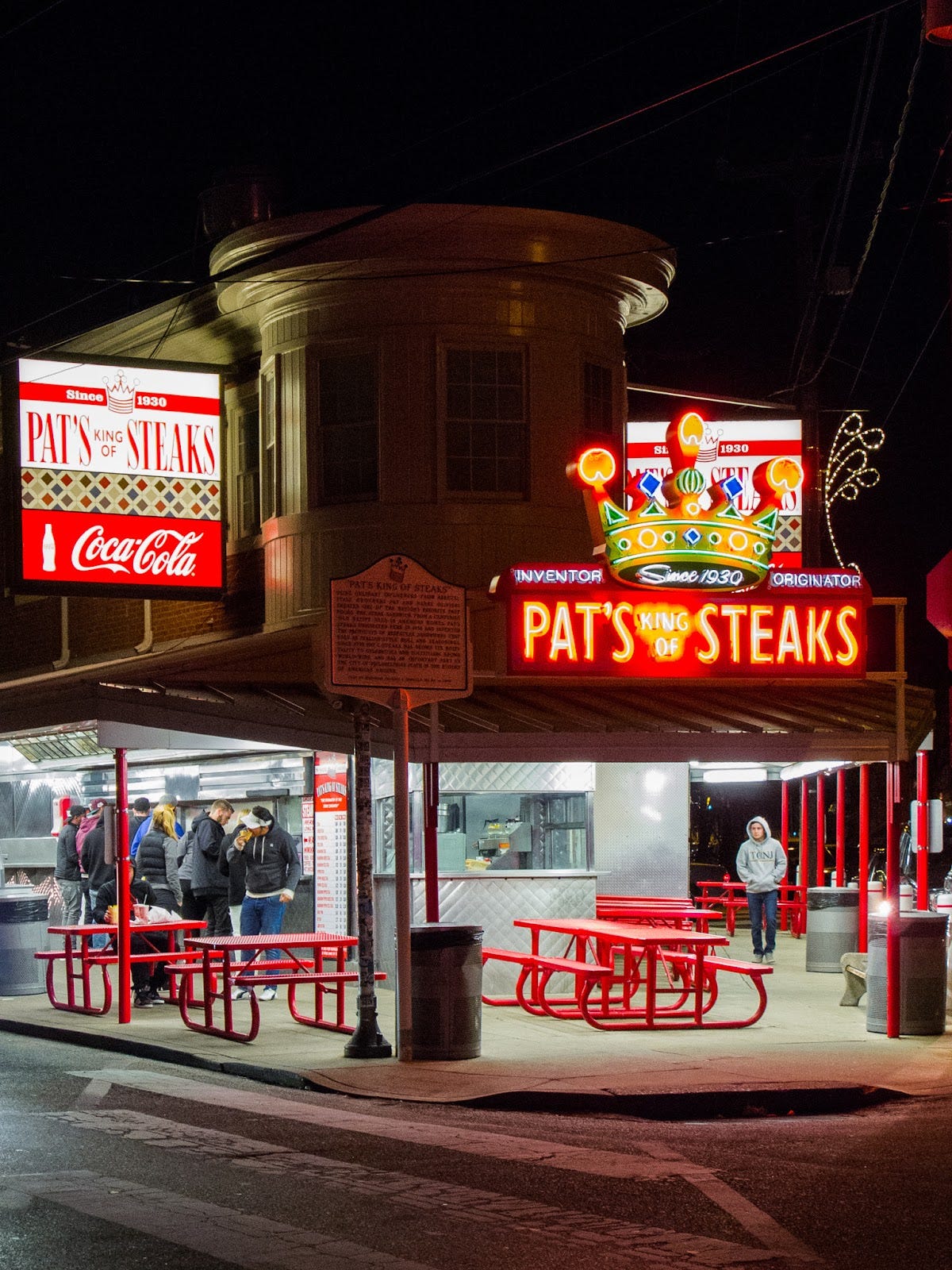
I had been to Pat’s before and have been to Pat’s since, but no cheesesteak or fries tasted as good as they did that one frigid evening. Maybe it was the company or my hunger or where the moon was, but the steaks just hit that day and haven’t ever since (my wife and I met in Philadelphia, so that likely played a role as well).
I have had better meals. I’ve tasted better food. But that meal was special.
However, context can make experiences go south when expectations get involved.
I am a pop culture junkie. I consume it feverishly but without any emotion. I’m like a friend who loves watching baseball but doesn't cheer for a team (this person does not exist BTW—nobody just loves baseball).
For example, I read the first Twilight book just to see what all the fuss was about (I still don’t have an answer; that book was 498 pages of hot garbage).
So recently, I was aware of the fervor that was the Barbie movie. The film was a sensation, and while I wanted to see it in theaters to be part of the monocultural conversation, I waited until the movie came out on digital demand and watched it. Sort of.
It took me three sittings to watch it.
When I was in high school, I took an English class where I studied Edgar Allan Poe and he said something to the effect that his poems should be read in one sitting (The Tell-Tale Heart is 2,093 words of brilliance and terror).
I try to watch films in one sitting (having kids makes this way more difficult), but I could not get through Barbie.
I’m not going to caveat this. It could have been better. Way better.
I don’t know if this is a conventional opinion but it feels unpopular. Barbie felt like a movement. It felt like a battle cry for women and anyone who felt marginalized. I was excited to see the film. I love underdog stories, and maybe that’s what made my disappointment so drastic.
Happiness is reality minus expectations.
I could not find who to attribute this quote to. There appears to be some discrepancy as to who said it first. But who said it doesn’t matter. What matters is that it’s true.
Maybe if Barbie were a quaint indie flick that I stumbled upon late at night I would have liked it more. Maybe if they didn’t market the film with a giant hologram outside the Burj Khalifa, I wouldn’t have been so disappointed.
But I doubt it.
My issue with Barbie wasn’t the message. It was the delivery. The film lacked nuance. The protagonists spent time looking directly into the camera giving monologues—that was the climax. I was just bummed and that’s probably my problem.
I unfairly expect my films (and art) to be simultaneously interesting, serious, engaging, funny, new and important. I just didn’t see what all the fuss was about.
It’s like when everyone lost their minds over the first Wonder Woman movie (93% approval on Rotten Tomatoes). I walked out of the film with a female friend of mine who said she was bummed. I asked why and she said that it was supposed to be a film about female empowerment but one of the keystone plotlines was her male love interest.
Context matters. Expectations matter. Nothing matters. Which one would you give up?
 | A guest post by
|